The P2CC partnership has brought together a community of practitioners and artists working across five European countries as ‘educators’ and ‘mentors’ supporting young people to access creative careers in a variety of non-formal and formal contexts.
Over the past few months P2CC ran a series of five online sessions, in which this community of practice has pooled and shared experiences. The process is informing the production of an online Creative Mentors Guide, which will shortly be launched as a key result of the project.
The sessions brought together a diverse group of mentors who operate in different national educational and cultural contexts and have a wide range of professional experience and specialist creative skills, that are highly differentiated across artforms. The P2CC Community of Practice encompassed practitioners in dance, music and performance, writing, visual arts, design and digital media and more. Some teach and tutor in educational institutions, others mentor young people in less formal settings.
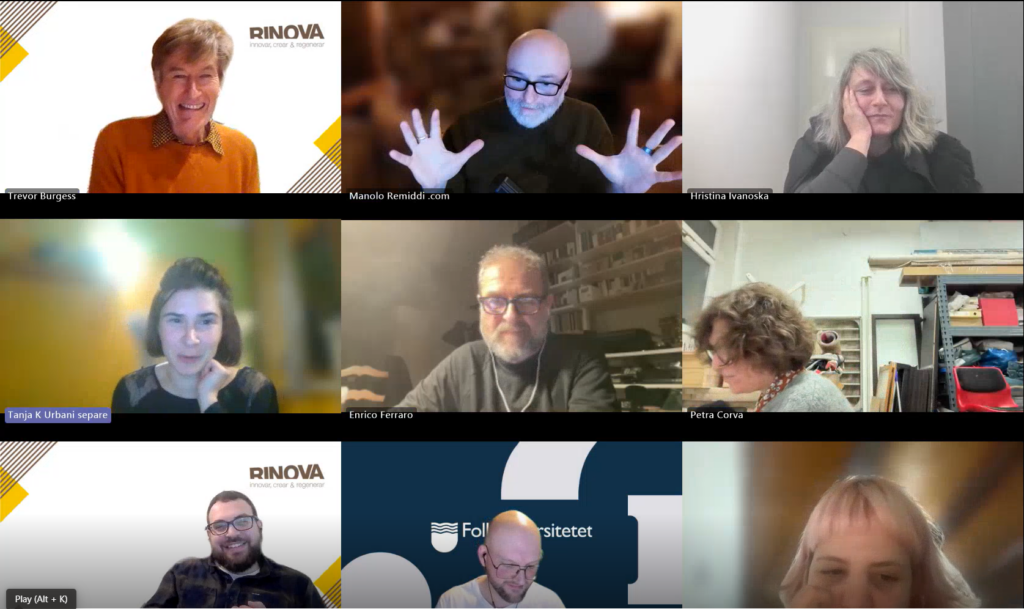
But rarely is there an opportunity for mentors to exchange experience with peers in other countries. A recurrent theme in the feedback was the value of meeting and exchanging with other creative mentors, with one participant admitting that she felt quite lonely in her field of dance pedagogy.
“I was excited to meet the participants from the other countries! To be able to share experiences and learn from people in other fields than just dance.”
” I really appreciated meeting all the creative mentors who contributed their perspectives and approaches to the theme. This meant that the focus was not primarily on receiving knowledge from others, but rather on discussing together and thereby gaining new insights that would be difficult to obtain by reading individual reports or other resources”
Recognising this, as the sessions progressed, we adapted the structure, spending less time on presentations and responding to feedback requesting more time in small groups in the digital break-out rooms for interchange and discussion.
Each session lasted two hours and focussed on a currently relevant topic in mentoring creative young people. The first session, led by Rinova, explored Digital and Enterprise Skills. The second session, led by Folkuniversitetet, focused on Inclusion and Equality. Urbani separe led Session three reflecting on the Social Impact of Creative Arts. In Session Four, Press to Exit investigated the topic of Critical Thinking and Media Literacy. The final session, led by MuLab, stimulated discussion around Wellbeing and Coping with Stress.
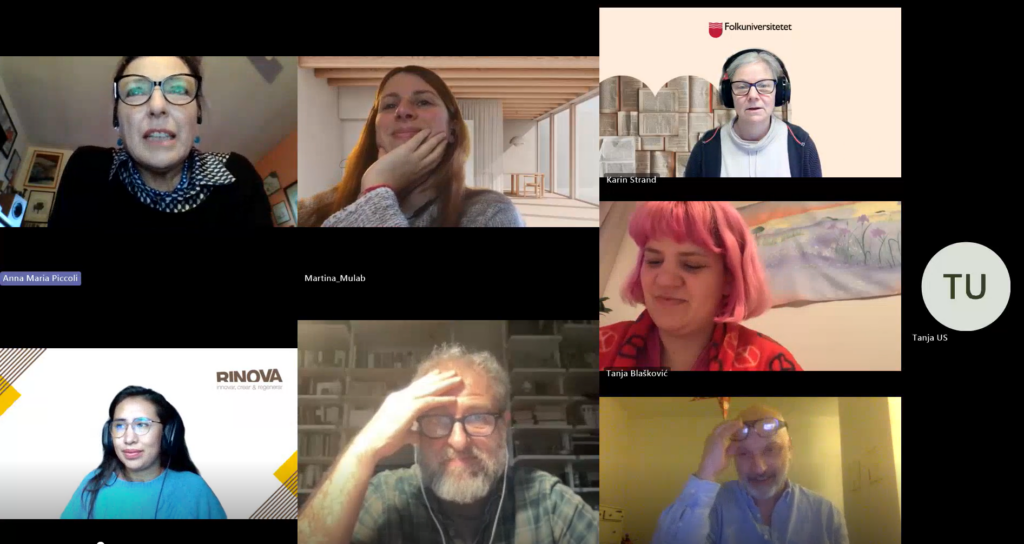
These are big topics, and we soon realised that we could not go into much depth in two hours. “We probably all underestimated the depth of the topics. We should have planned fewer things”. By the time we reached the last session, the format had been distilled to a very brief introduction to the theme with the rest of the time to discussion focused sharply on just three key questions. “This was the most successful yet, because just focusing on some simple question actually enabled us to go into the subject more deeply and from different perspectives”
Numbers were limited to a maximum of five participants from each of the five countries. A lot of time in the first session was spent presenting ourselves to the group, and it was suggested that in future an initial session could be set up just for everybody to introduce themselves.
The first session explored the advantages and disadvantages of mentoring online. Online video calls made the whole process of transnational exchange possible, but the first session also demonstrated one of the disadvantages of technology, when, it doesn’t always work as it should. However, technology also enabled us to gather input and feedback that will inform the content of the Creative Mentors Guide.
As a conclusion, the process has been very successful in anchoring the production of the Guide for Creative Mentors in the practical professional experience of a wide constituency of practitioners engaged in mentoring in very diverse contexts across the five different countries. It provided a virtual space in which participants felt comfortable to share expertise and experiences, that “contributed to strengthening both personal awareness and professional competencies”. Sharing with colleagues from different fields and experiences, hearing different perspectives, was consistently the most valued aspect of the sessions in the feedback.